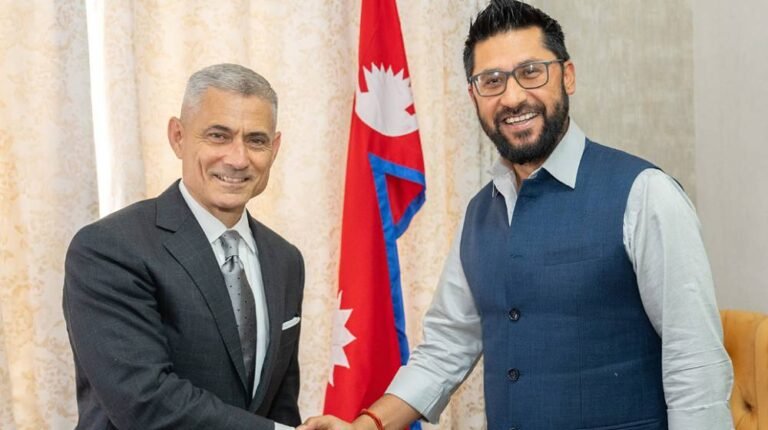




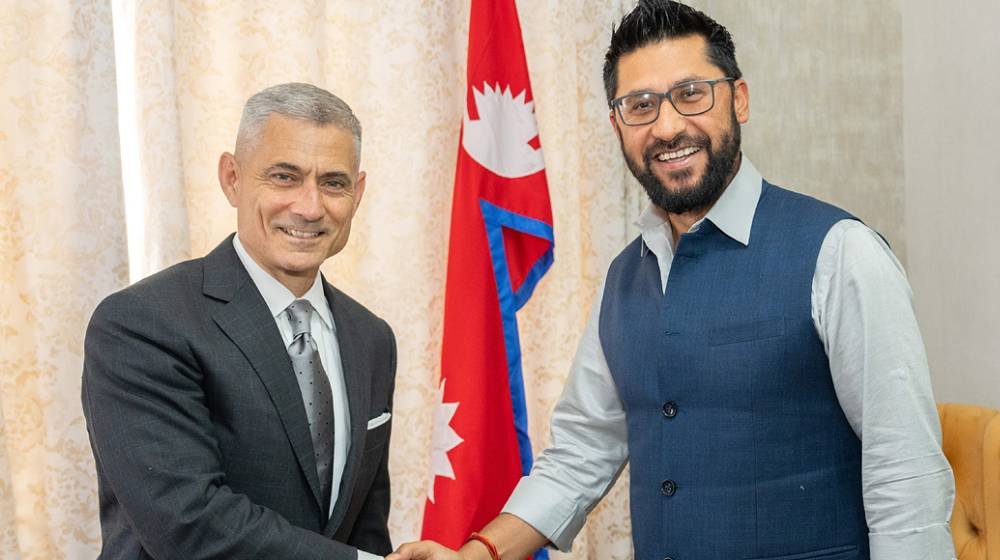
There is a small but telling detail in how U.S. Assistant Secretary of State Samir Paul Kapoor arrived in Kathmandu recently. He flew directly from Washington — no layover in Delhi, no stopover in a neighbouring capital. In diplomacy, the route you take often says as much as the words you speak. The message was clear: Nepal is no longer a footnote in a South Asian itinerary. It is becoming a destination in its own right.
A leader who changes the calculation
Much of this renewed attention traces back to one man: Prime Minister Balendra Shah, widely known as “Balen.” A former rapper and civil engineer who rode a wave of youth discontent into the highest office, Shah is a genuinely unusual figure in Nepali politics. He belongs to no established party, carries no Cold War-era ideological luggage, and — crucially — governs with a commanding majority of 182 seats in Parliament. For a country that has cycled through more than a dozen governments since the early 1990s, that kind of stability is almost radical.
India’s Prime Minister Modi has already extended an invitation for Shah to visit. China is actively recalibrating its approach to the new government. And Time magazine placed Shah among its 100 most influential people in the world — recognition that has not gone unnoticed in foreign ministries across the globe.
Diplomacy with a fresh slate
What makes this era genuinely different is the absence of ideological predictability. For decades, Nepali leaders arrived at the negotiating table pre-labelled — Congress-leaning and therefore tilting toward India, or Communist-leaning and therefore seen as closer to Beijing. Shah defies both categories. He is, as observers have noted, politically unclassifiable in the old sense — and that neutrality is, paradoxically, a form of power.
It allows Nepal to engage the United States, India, and China simultaneously without any of them feeling that the others have a structural advantage. When Kapoor sat down in Kathmandu — first with RSP President Rabi Lamichhane, then with a group of Nepali technology entrepreneurs — the conversations ranged freely: digital infrastructure, artificial intelligence ethics, cybersecurity, American tech expertise. The breadth of those talks reflects a Nepal that is trying to be useful to the world, not merely tolerated by it.
Key developments at a glance
- Kapoor flew directly Washington – Kathmandu, bypassing regional capitals
- Highest-level U.S. diplomatic visit since Balen’s government formed
- Talks covered AI ethics, cybersecurity & digital infrastructure
- PM Shah holds a near two-thirds majority — rare stability for Nepal
- Modi has extended a formal invitation for Shah to visit India
- Uber and Starlink reportedly exploring the Nepali market
From passive geography to active strategy
The phrase Nepal has used for centuries — “buffer state” — has always carried a slightly diminishing undertone. A buffer exists to absorb pressure between larger forces. It is, by definition, reactive. Shah’s government is quietly but deliberately replacing that framing with something more assertive: Nepal as a “vibrant bridge” — a connector, an active participant in regional prosperity rather than a passive cushion between giants.
The shift is more than rhetorical. Shah has reportedly insisted that foreign ambassadors follow proper diplomatic channels and coordinate through the Ministry of Foreign Affairs rather than seeking informal, back-channel meetings. It is a small procedural change with a large symbolic meaning: Nepal is reasserting the norms of sovereign equality.
There is also a structural problem to fix. Nepal currently manages its foreign relations through six separate ministries — Foreign Affairs, the Military, Labour, Finance, and others — each operating with little coordination. For the “vibrant bridge” vision to work, the Ministry of Foreign Affairs needs to be reinstated as the central hub, ensuring that every interaction, from trade talks to military cooperation, advances a unified national strategy.
The road ahead
None of this will be simple. Balancing the United States, India, and China simultaneously is the kind of high-wire act that has undone more experienced governments. The interests of these three powers overlap, contradict, and sometimes collide — and Nepal sits squarely at the intersection. But the country has something it has rarely had before: a stable government, a leader without an obvious allegiance, and a window of genuine global attention.
Whether Kathmandu can convert that attention into investment, infrastructure, and long-term partnership is the real test. For now, the bridge is being designed. The blueprints look promising. The question is whether the builders can hold steady as the giants on either side pull in different directions.

Gen Z Press delivers trusted and timely global news for the new generation. We bring you world updates, Gen Z trends, entertainment, lifestyle, and digital culture with clarity, simplicity, and accuracy. Stay informed, inspired, and connected with Gen Z Press — your reliable destination for global news and youth-driven stories.
We welcome your opinions at ✉️ letters@genzpress.com