




(GenZpress.com) – Security forces in Nepal used disproportionate and excessive force against youth-led protests in Kathmandu on September 8, 2025, which subsequently triggered a second day of widespread violence, arson, and mob attacks. Human Rights Watch (HRW) has urgently called on the new interim government, led by former chief justice Sushila Karki, to launch a transparent and independent investigation into both the excessive use of force by police and the coordinated attacks that occurred the following day.
The interim government must investigate the actions of security forces, allegations of criminal infiltration, and the role of anyone who may have ordered unlawful acts during the two days of turmoil.
The Genesis of the ‘Gen Z’ Movement
The violence was fueled by increasing discontent among young Nepalis, stemming from endemic corruption in politics, socioeconomic inequality, a failure to ensure rights such as an adequate standard of living, and a lack of accountability for previous human rights abuses.
The immediate trigger for the September 8 demonstrations was the interim government’s sweeping ban, announced four days prior on September 4, on 26 social media platforms and messaging apps. This ban was supposedly imposed because the platforms had failed to register with authorities following an August 25 cabinet directive, but many Nepalis viewed it as a blatant attempt to silence political criticism.
The protest movement was intentionally “leaderless,” quickly mobilizing between September 5 and 7, primarily through the communication platform Discord. Though Discord was technically banned, organizers and participants utilized Virtual Private Networks (VPNs) to communicate, with key Discord servers swelling to tens of thousands of members. While the dominant theme was peaceful protest, organizers noted that the idea of “infiltrators” advocating violence was present on the platform early on.
Day One: Disproportionate Lethal Force (September 8)
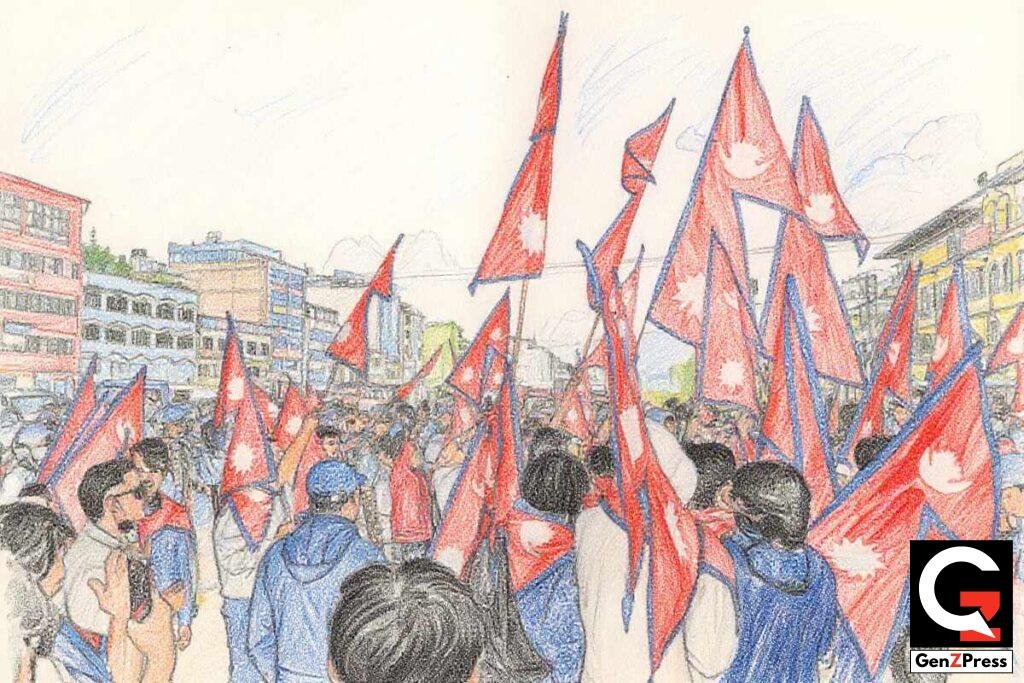
Thousands of young protesters initially gathered at Maitighar Mandala, the city’s typical assembly point, before marching toward the Parliament building at Naya Baneshwor Chowk. Organizers had planned to keep the demonstration peaceful, with some planning to give flowers to the police. Many participants were described as never having attended a protest before, creating a “joyful” atmosphere at the outset.
However, the situation rapidly devolved. Police officials later admitted they had underestimated the massive size of the crowd, a failure in intelligence and preparation that may have contributed to the ensuing events.
At around 11:30 a.m., protesters toppled a single police barricade on the street leading to Parliament, with some approaching from the direction of the parliament itself to assist in pulling it down. As the crowd advanced, police used tear gas, water cannons, and batons. Protesters, who gathered around the main gate, began throwing stones at the police.
At approximately 12:30 p.m., the government declared an emergency curfew in the area, though witnesses and journalists interviewed by HRW were not aware of any public announcement.
Indiscriminate Shooting and Casualties
Between roughly 12:30 p.m. and 4 p.m., police repeatedly used lethal force to disperse the youth. HRW found that police indiscriminately fired on protesters multiple times over three hours. Witnesses interviewed did not hear any warnings before police started using lethal force.
Evidence suggests the police opened fire with metal bullets within minutes of the curfew order. One protester, shot in the leg after pushing through the barricade, stated that the distance between police and protesters was only about seven meters when the initial shots were fired.
- A 20-year-old university student who was shot through the shoulder at around 1:40 p.m. confirmed that there was “no violence” at the moment she was injured, stating the area was “very peaceful” before they started firing.
- One video, verified by HRW, captured the moment a 17-year-old boy in a school uniform, later identified as Shreeyam Chaulagain, was shot in the back of the head while walking away from the parliament, clapping his hands above his head. He did not survive.
- Officers from the Nepal Police and the paramilitary Armed Police Force (APF) were seen firing at protesters just in front of the main parliament gate, with other officers firing military rifles from inside the parliament grounds.
These actions led to the deaths of 17 people in Kathmandu that day, along with 2 outside the capital, and injured hundreds.
Lethal force is only permissible when strictly unavoidable to protect life from imminent danger. HRW’s analysis of footage and witness accounts indicates that the severity of danger did not justify the intentional use of lethal force. A retired senior police official confirmed that police failed to follow proper procedures for dispersing protests and the use of lethal force.
In the afternoon and evening of September 8, police personnel, including the Special Task Force (STF), detained at least 34 protesters inside the parliament compound. The detainees reported being beaten with batons, threatened with being shot, and having their phones and identity documents destroyed.
Day Two: Arson, Looting, and Targeted Mob Attacks (September 9)
The killings on September 8 sparked the second day of escalating violence. The Home Minister resigned and the social media ban was lifted on the evening of September 8.
On September 9, while some Gen Z protesters returned to parliament and managed to occupy the building (which was later burned by unidentified people), the day was marked by widespread, coordinated arson and mob attacks carried out by groups, some of whom were apparently not linked to the original Gen Z movement.
Witnesses and analysts suspected that the violence was influenced by “infiltrators” affiliated with various political movements. Some attacks appeared highly selective, leading a businessman to note that neighboring businesses were often left unscathed. There were reports of social media and Discord posts encouraging attacks on specific properties.
Key incidents of September 9 violence included:
- Attacks on Authorities: Mobs overran almost all police stations in Kathmandu, looted weapons, and forced police to flee. Three policemen were killed in mob attacks.
- Targeting Politicians and Government: Mobs severely beat politicians and set fire to their homes. Then-Prime Minister K.P. Sharma Oli resigned on the afternoon of September 9 and had to be rescued by military helicopter. Key government buildings, including the Supreme Court, the Presidential Palace (Shital Niwas), the Parliament, and Singha Durbar (which houses the Prime Minister’s office and other federal offices) were set ablaze.
- Media and Education: Kantipur Television headquarters was vandalized by armed men who assaulted four staff members and set fire to vehicles, causing damage that took the channel off air for 70 hours. The offices of the Kantipur Group’s daily newspapers and the Annapurna Post were also burned. Ullens School in Khumaltar, which many Nepalis associated with then-Foreign Minister Arzu Rana Deuba, was attacked, leaving facilities “all burned, destroyed”.
- Incarceration and Records: Attacks on jails led to the freeing of thousands of prisoners. Men were seen removing large volumes of files from cupboards inside the Supreme Court and burning them in the parking area before the building was set ablaze. Records were also reportedly destroyed at the attorney general’s office.
Security Failure to Protect Civilians
Crucially, witnesses reported that security forces were largely absent as arson spread across the city, failing to protect individuals and properties under attack.
Some attacks demonstrated an apparent police stand-down. For example, a person involved in the burning of the Prime Minister’s official residence at Baluwatar stated that police posted there said, “‘We won’t shoot at you,’ and 10 to 15 minutes later they opened the gate,” allowing entry. A separate witness described a “biker gang,” armed with weapons like khukuris (large knives), who made firebombs using fuel from their motorcycles to set fire to the principal building at Singha Durbar.
The arson continued until around 10 p.m. on September 9, when the army was finally deployed. The two days of violence resulted in the deaths of at least 76 people nationwide. In Kathmandu alone, 47 bodies were received at one morgue, including 3 policemen. Pathologists determined that 35 deaths were due to “high velocity gunshot wounds” to the head, neck, chest, or abdomen.
The Call for Accountability and Reform
Following the chaos, Gen Z representatives consulted with supporters on Discord and reached an agreement on September 12 with President Ram Chandra Poudel to dissolve parliament and appoint Sushila Karki as head of an interim government tasked with conducting fresh elections.
The Karki government has since established a judicial commission of inquiry to investigate the deaths.
HRW stressed that this commission can only succeed if it acts transparently and ensures that those responsible for breaking the law are investigated and prosecuted. The authorities must recognize and address the underlying issues of corruption and the failure to ensure rights, which spurred the protests in the first place.
Meenakshi Ganguly, deputy Asia director at Human Rights Watch, emphasized the need for accountability for all parties: “The recent violence in Nepal included serious human rights violations, and those responsible should be held accountable, whether they are security forces or political actors”.
As of November 10, police had arrested 423 individuals allegedly responsible for violence on September 9, but no action was known to have been taken against officers who unlawfully opened fire on peaceful protesters on September 8. HRW asserts that it is crucial to reverse the decades-long tendency in Nepal to bury investigations and stall prosecutions to bring about genuine accountability and security sector reform.

Gen Z Press delivers trusted and timely global news for the new generation. We bring you world updates, Gen Z trends, entertainment, lifestyle, and digital culture with clarity, simplicity, and accuracy. Stay informed, inspired, and connected with Gen Z Press — your reliable destination for global news and youth-driven stories.
We welcome your opinions at ✉️ letters@genzpress.com