


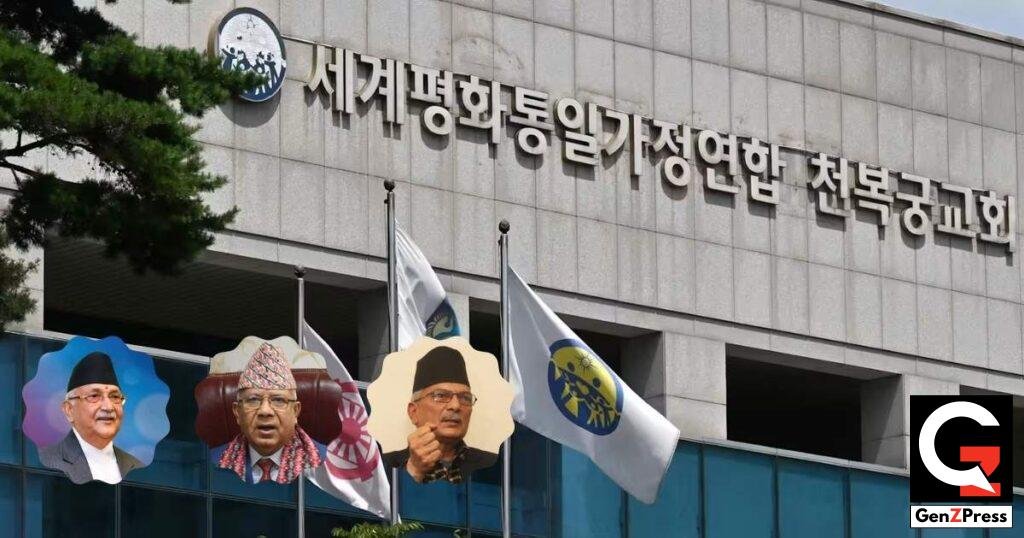
Midway through the chatter—when Kathmandu’s tea shops were already buzzing—an uncomfortable question began floating around: how deep does religion really reach into our politics, and who’s quietly footing the bill?
Recently leaked documents, said to have come from insiders who broke away from South Korea’s Unification Church, have kicked up a storm. The papers suggest something many people suspected but few could pin down—long-term financial and strategic involvement by the church with Nepal’s major political players, stretching across election cycles and ideological lines. Uneasy stuff.
The documents were obtained by the Korean investigative journalism outlet Newstapa. Buried inside the correspondence are references that point to sustained, behind-the-scenes relationships with Nepal’s dominant political forces. Not casual handshakes. Strategic ties. The kind that take years to nurture.
Names appear. Big ones. Former prime ministers, no less—KP Sharma Oli of the CPN-UML, Madhav Kumar Nepal of the Nepal Communist Party, and Dr. Baburam Bhattarai, patron of the Progressive Democratic Party. Seeing all of them listed together feels… strange. Maybe even jarring.
According to the leaks, the UML is said to have benefited electorally through the Nepal Family Party, an outfit linked to the Unification Church and founded by Ek Nath Dhakal. The suggestion is that Dhakal acted as a conduit—helping channel election support, manage finances, and widen political access. If true, that’s not a small allegation. Not at all.
Dhakal, who has aligned with the UML in election after election since 2017, reportedly signed another four-point agreement with the party for the upcoming vote scheduled for Falgun 21. The agreement—dated Magh 4—states that the UML would, “at an appropriate time,” facilitate representation for the Nepal Family Party in both the federal parliament and provincial assemblies. Vague wording. Conveniently vague. And yes, it’s already raising eyebrows about whether church-linked influence could again shape the ballot.
This wouldn’t be unprecedented. In the 2022 elections, the UML secured Dhakal a proportional representation seat from the Khas Arya cluster. Meanwhile, correspondence connected to Madhav Kumar Nepal allegedly includes requests—dating from the first federal election in 2017 through the 2022 general polls—for immediate access to millions of US dollars to cover campaign expenses.
One email, in particular, stands out. Dhakal is said to have written directly to Yong Jong Sik, the Unification Church’s Asia regional president, asking for campaign funds to support election outreach and bolster the UML. On top of that, there’s a request for an extra $20,000 per month to run the Nepal Family Party and prepare for elections. Casual? Hardly.
Then there’s the money talk—always the awkward part. One message reads, more or less: “I sincerely apologize, but at least $500,000 is necessary. I would be grateful if it could be arranged as soon as possible. Initially, $500,000 was used for overall election costs, and an additional $500,000 is required to support the Family Party and key leaders.” Direct. Almost blunt. A little too honest, perhaps.
After the 2017 elections, when the UML–Maoist alliance formed the government, Prime Minister Oli appointed Dhakal as Minister for Peace and Reconstruction. During Dhakal’s tenure, Kathmandu hosted the Asia–Pacific Summit 2018—chaired by Hak Ja Han, the wife of Unification Church founder Sun Myung Moon. The event drew heavy criticism for blurring the line between diplomacy and religious promotion. It was around then that the phrase “Holy Wine” quietly slipped into Nepal’s political vocabulary. Funny how language works.
Madhav Kumar Nepal, now co-chair of the Nepal Communist Party, has flatly rejected the allegations. He’s called them baseless, false, and frankly irresponsible. “These claims are completely untrue and damaging to relations with friendly nations,” he said, adding that the accusations are beyond his imagination. He insists he has always condemned wrongdoing and that none of the leaked claims hold any truth. Strong words. Defensive, yes—but perhaps expected.
Dr. Baburam Bhattarai, too, expressed skepticism. The timing alone, he said, makes the story suspicious. “The authenticity and credibility of this information are questionable,” he noted. “It doesn’t align with the present context.” He reiterated his long-held stance on secularism—neither for nor against any religion. Then came the rhetorical punch: if foreign powers had really invested in him or his party, he asked, would they still be struggling the way they are today? “This is outright falsehood,” he concluded.
Some of the correspondence goes further, outlining plans by the church to include Nepal’s communist leaders in overseas visits, ideological “training,” and long-term political grooming. Grand designs. Not all of them materialized, though. Attempts to take entire blocs of allied lawmakers to third countries for exposure to church ideology reportedly never fully got off the ground.
Meanwhile, back in South Korea, the church’s 82-year-old leader Hak Ja Han is under investigation. Authorities are probing allegations that she bribed associates of former President Yoon Suk Yeol, including his wife. Korean special prosecutors are treating the leaked documents as potential evidence of political lobbying.
The Unification Church, for its part, denies everything. It claims the documents aren’t official and were merely informal papers created by a former international headquarters director, Yun Yong Ho, allegedly trying to inflate his own influence. The Nepal Family Party and Ek Nath Dhakal have also rejected accusations of foreign funding or illicit correspondence.
Still. And this is where it lingers. The documents now in public view raise uncomfortable, nagging questions—about transparency, about foreign religious-political networks, and about just how independent Nepal’s national politics really are. Questions that don’t go away easily. Not this time.

Gen Z Press delivers trusted and timely global news for the new generation. We bring you world updates, Gen Z trends, entertainment, lifestyle, and digital culture with clarity, simplicity, and accuracy. Stay informed, inspired, and connected with Gen Z Press — your reliable destination for global news and youth-driven stories.
We welcome your opinions at ✉️ letters@genzpress.com